

What is embedded finance
· Roland Völkel
Summary
- Embedded finance means a company without its own license offers financial products inside its own product. The platform owns the interface and the customer relationship; a licensed provider carries settlement and regulatory duties.
- Every setup has three roles: the license holder, the infrastructure provider with the API, and the distributing platform. Banking as a service describes the provider side of that model; embedded finance describes the result in the product.
- Common cases are financing at checkout, daily payouts on marketplaces, business accounts and cards inside vertical software, and insurance sold with the product.
- Platforms embed because it monetizes an existing user base and keeps a process inside their own product, without taking on the regulatory workload themselves.
- Embedded benefits follow the same distribution model, but the regulated core sits in payroll tax law rather than banking law. That is why the provider set differs from payments.
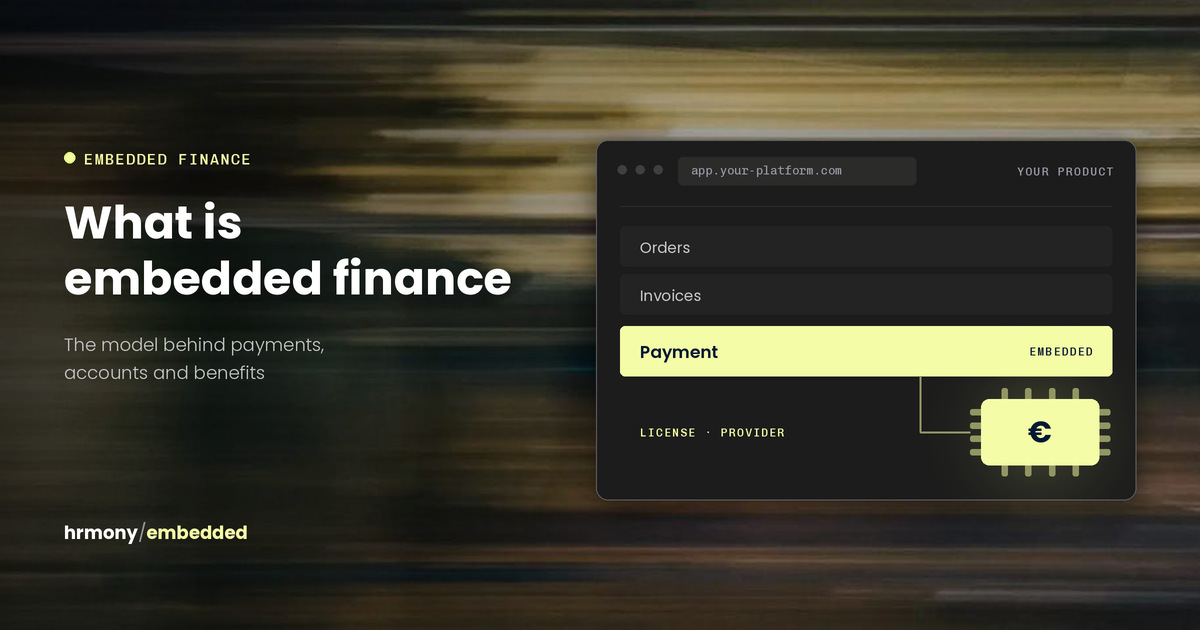
Embedded finance means a company without a banking license offers financial products inside its own product: payments, lending, accounts, cards, or insurance. The license, the settlement, and the regulatory responsibility sit with a specialized provider in the background. What the customer sees is the platform they were already working in.
The three roles behind embedded finance
Every embedded finance offer splits across three parties:
- License holder – a bank, e-money institution, or payment institution. Carries the license, regulatory reporting, anti-money-laundering checks, and liability.
- Infrastructure provider – exposes those functions as an API or SDK, with a sandbox, documentation, and operations. Often the same company as the license holder; that provider model is called banking as a service.
- Platform – embeds the functions, designs the interface, sets the price, and keeps the customer relationship.
The appeal for the platform: it sells a regulated product without carrying the regulatory workload itself. The cost: it gives up part of the margin and ties part of its product to someone else's roadmap. For who occupies the field today, see the overview of embedded finance companies.
What embedded finance looks like in practice
Four patterns cover almost every case:
- Financing at checkout. The shop shows installments; the credit decision and the default risk sit with the lender.
- Payouts as a product feature. A marketplace pays drivers, sellers, or creators daily instead of monthly, with a payment institution behind it.
- Account and card inside vertical software. An industry platform gives its customers a business account and card in the app they already use.
- Insurance with the product. Coverage is offered inside the booking or checkout flow rather than sold separately.
What they share: the financial product is not the platform's business. It is one step in a process that already happens there.
Why platforms embed financial products
Three reasons, in this order:
Revenue on an existing user base. A recurring per-user margin, with no new customer acquisition. That is why embedded finance usually comes out of product, not sales.
Retention. A platform that handles payments, payouts, or compensation is harder to replace than one that only displays data. Switching cost grows with every process that lives inside the product.
Control of the process. The platform keeps the interface, the data, and the timing instead of handing users to someone else's web app.
The counterpoint belongs in the same breath: this works when the embedded product connects to a process the platform already runs – payroll, spend, employee data. Bolted on as a referral link, it earns little and adds overhead.
The regulated part stays with the provider
Regulation does not disappear in this model, it just sits with someone else. In Germany, providing payment services falls under the ZAG and BaFin supervision; lending and deposit business fall under the KWG. The platform designs and sells but does not provide the regulated service itself. For the platform, that moves the risk from supervision into the contract: who is liable when an audit comes is settled by the agreement with the provider, not by the integration work. Which is why the question belongs in discovery, not in the fine print.
How employee benefits fit into this category
Embedded benefits are embedded finance applied to compensation: a platform offers benefits such as a meal subsidy, vouchers, or mobility inside its own product, while an infrastructure provider handles payout, receipt checks, and payroll tax treatment. The definition and the technical model are in what are embedded benefits; the detailed distinction is in embedded finance vs. embedded benefits.
| Category | What gets embedded | Regulated core | Who carries it | What the platform earns |
|---|---|---|---|---|
| Embedded payments | Payments, payouts, cards | Payment services law (PSD2, ZAG in Germany) | Payment institution, banking-as-a-service provider | Share of transaction and interchange |
| Embedded lending | Financing at the point of sale | Credit and banking law | Bank or lending platform | Commission per contract |
| Embedded insurance | Coverage with the product | Insurance supervision and distribution rules | Insurer or managing agent | Distribution commission |
| Embedded benefits | Benefit modules in HR and payroll flows | Payroll tax law, receipt evidence, liability | Benefits infrastructure provider | Recurring margin per user per month |
What makes benefits different from payments
The regulated core sits in payroll tax law, not banking law. That sounds like a footnote, but it changes the whole provider set: a banking-as-a-service provider can move money, and cannot check individual receipts against German income tax rules or produce payroll-ready monthly files.
Two examples of how specific that core is:
- Meal subsidy (Hrmony Embedded module Meal): up to €7.67 per working day, up to €115.05 per month. Net for the employee; the flat-rate tax on the taxable portion is carried by the employer, not the employee.
- Voucher benefit (module Voucher): up to €50.00 per month tax-free, but only on top of salary and with no carry-over into the next month. Exceed the limit and the full amount becomes taxable.
One point of contact with the payments world remains: voucher and card products have to be structured as a limited-network instrument under the German ZAG. That is where benefits tax law meets payment regulation directly, and where in-house builds designed as a simple balance account tend to fail.
Three questions before you embed anything
- Does the product sit close to a process your users already run in your platform – payroll, employee data, spend? The closer the data, the smaller the step for your customers and the more plausible the extension.
- Who is liable when an audit comes, and does the contract say so in writing?
- Does the per-user margin cover integration and support, or would it need volume you don't have?
Hrmony Embedded is the benefits side of this model: benefit modules over one API, with receipt checks, assumed liability on the meal benefit, and monthly payroll tax reporting files. The modules and the integration path are on the Hrmony Embedded overview.