

What are embedded benefits
· Roland Völkel
Summary
- Embedded benefits are employee benefits a platform offers inside its own product through a provider's API, instead of building them itself.
- The model mirrors embedded finance: the platform keeps the interface and the customer relationship; the provider runs payout, receipt checks, and payroll-tax handling.
- For platforms, it's a new recurring revenue stream on the existing user base, plus stronger retention – with no benefits engineering.
- Build vs. buy: building in-house means owning receipt checks, tax liability, and regulatory updates indefinitely; embedding shifts that to the provider.
- Best fit for HRIS, payroll, employer of record, accounting, and vertical SaaS with a workforce angle.
Embedded benefits are employee benefits that a platform offers inside its own product, running on a specialist provider's infrastructure instead of being built in-house. The platform adds ready-made benefit modules through an API; payout, receipt checks, and payroll-tax handling happen in the background at the provider. To the end customers – companies and their employees – it looks like a native part of the platform they already use.
Embedded benefits in one sentence
Embedded benefits move benefits out of a separate tool and into the product a company already runs. Instead of buying standalone benefits software, the customer turns on meal, voucher, or mobility benefits right where they already work – in the HR system, the payroll tool, the expense app. The platform owns the interface; the infrastructure provider owns the benefits logic behind it.
The model behind it: embedded finance
Embedded benefits are the benefits version of embedded finance. Embedded finance is when non-banks – stores, SaaS tools, marketplaces – offer financial services like payments, lending, or accounts inside their own product without becoming a bank. Apply the same idea to employee benefits and you get embedded benefits: a platform offers tax-advantaged benefits without becoming a benefits provider that runs receipt checks, tax logic, and payouts itself. The financial side of this shift is well established; the benefits side is still being named.
How embedded benefits work technically
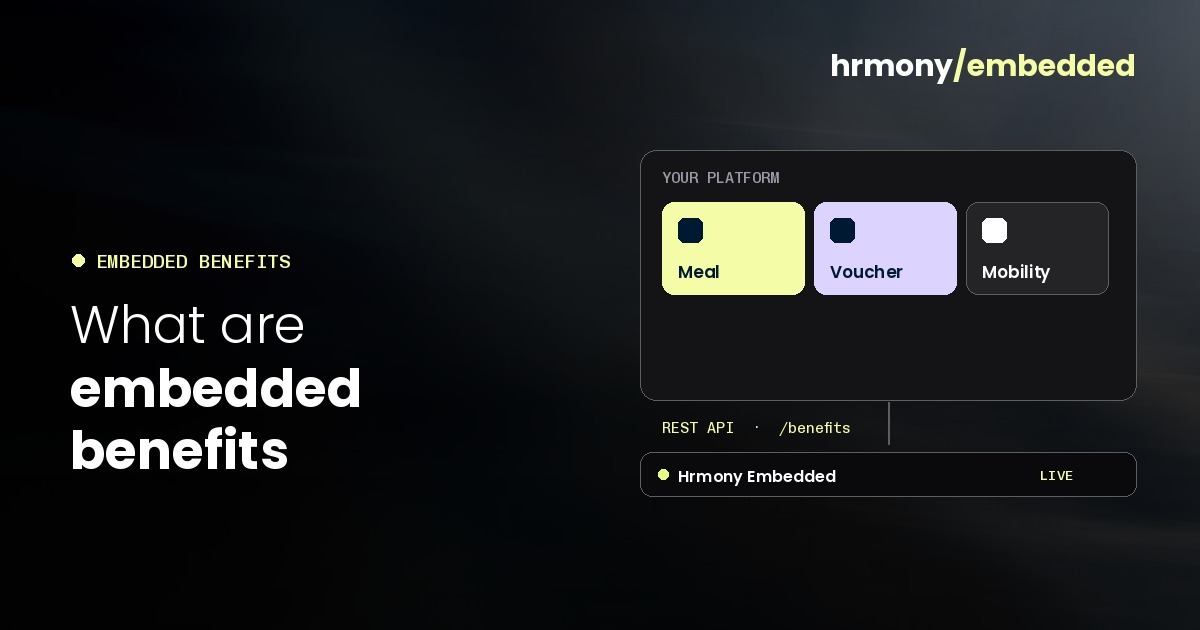
Embedded benefits draw a clean line between what the user sees and what runs in the background. Up front is the platform, with its own branding and interface. Behind it sits a REST API or SDK that connects the benefit modules. In the backend, the provider handles user management, payout logic, and payroll-tax processing.
Concretely: a payroll platform switches on the Meal module. Employees at its customers get a meal benefit of up to €7.67 per working day, net for the employee. The platform shows this in its own app; the line-item receipt checks – and the liability for them – sit with the infrastructure provider.
Build or embed?
For most platforms, building benefits in-house costs more than it looks. Build it yourself and you own receipt checks, payout logic, tax liability, and every regulatory change – work that doesn't set your product apart. Embedded benefits hand that part to the provider; the platform keeps the interface, the customer relationship, and the margin.
The exception is clear: if benefits are your core product, you are the provider, and embedding isn't your question. For everyone else, the question isn't whether to offer benefits, but whether to operate the infrastructure behind them or buy it.
What embedded benefits give a platform
For a platform, embedded benefits are mainly a new, recurring revenue stream on the existing user base. The partner buys a module at a fixed per-employee API fee and sets its own sale price; the margin stays with the partner. There's also a retention effect: benefits wired deep into HR and payroll processes are harder to rip out, which lowers churn. The third point is speed – a module goes live in weeks, not quarters, with no benefits engineering of your own.
Which platforms it fits
Embedded benefits fit platforms whose users are employers and their employees. That's mainly HR and workforce systems (HRIS), payroll, employer of record, accounting, spend management, and vertical software with a workforce angle. The closer a platform sits to people, pay, or spend, the more naturally benefits fit in.
Hrmony Embedded provides this infrastructure as a single API – with modules for Meal, Voucher, Mobility, Internet, and more. For how an integration works in practice, see the Embedded landing page.