

Reduce platform churn with embedded benefits
· Roland Völkel
Summary
- Platform churn is your customers leaving your product, not employee turnover inside those customers. Keep the two metrics apart.
- A benefit module moves the cancellation decision from a handful of admins to every employee, because switching it off removes a monthly net amount from their pay.
- Benefits create usage on every working day instead of a few admin logins a month.
- Switching providers mid-year breaks a payroll-relevant chain with statutory record-retention periods, which is a different cost than a data export.
- The lever works on renewal and consolidation churn, not on churn caused by failed onboarding or a weak core product.
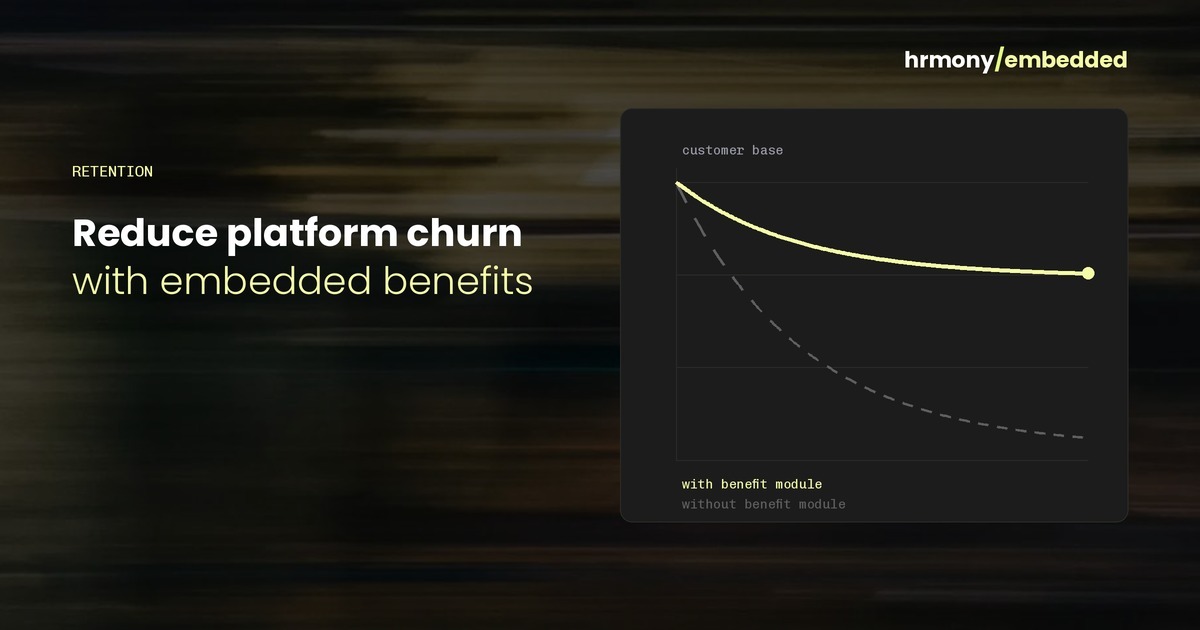
Reducing platform churn means raising your customers' switching costs without cutting your price. An embedded benefit module does that in a place the usual retention levers never reach: it pays a net amount, every month, to every single person working at your customer. Cancelling is no longer a tooling decision. It is a visible pay cut.
One distinction first, because it slips constantly in this topic: this is about your churn, not your customers'.
Platform churn is not employee turnover
Platform churn is the rate at which companies cancel or shrink their contract with you, tracked as logo churn and net revenue retention. Employee turnover is the rate at which people leave one of those companies, and it is tracked by their HR team.
A benefit module touches both, but only the first number belongs in your board deck. The second is your customer's reason to switch the module on and keep it on – evidence, not a target. Mixing them builds the business case in the wrong place: it justifies a platform feature with a metric nobody at your company owns.
Where benefits sit among customer retention strategies
Most retention strategies work on the same small group of people. Faster time-to-value, executive business reviews, deeper integrations, usage-based pricing that follows the customer's growth, and multi-product adoption all aim at the buyer and the admins around them.
Embedded benefits belong to the last category, multi-product adoption, but with a different payoff profile. Adding a second reporting module raises the value of your product for the same three people who already log in. Adding a benefit module raises it for everyone on payroll. That is the whole argument, and it is worth being precise about why it holds.
Three mechanics that move renewals
The cancellation becomes visible
In B2B SaaS, switching costs are usually carried by a few people: admins learn a new interface, IT re-points integrations, reporting breaks for a quarter. Unpleasant, but negotiable – which is why renewals so often collapse into the question of whether a line item is worth its price.
A benefit module changes that question. In Germany, the Meal module runs up to €7.67 per working day, or €115.05 a month at 15 billing days. It is valued using the official benefit-in-kind rate; employees receive the amount net because the employer covers the 25% flat-rate tax on the taxable portion (§ 40 (2) sentence 1 no. 1 EStG), and the flat-rate-taxed portion is exempt from social security contributions provided the tax is remitted in the same payroll period (§ 1 SvEV). The Voucher module runs up to €50 a month, free of both wage tax and social security contributions, as long as it is granted on top of regular pay and the monthly threshold is not exceeded (§ 8 (2) sentence 11 together with § 8 (4) EStG).
At that point the renewal stops being a software decision and becomes a compensation decision. In many companies it is no longer answered inside one department alone, and it has to be explained to the workforce. That is the actual effect: not that switching gets more expensive, but that it gets noticed.
Daily usage instead of three admin logins a month
Admins open an HRIS or an accounting tool on deadlines. A meal benefit is used every working day: submit a receipt, check the balance, see the reimbursement. The module produces a usage frequency inside your product that your core feature structurally cannot – and it does so for the whole workforce, not just the seats in the admin area.
That counts twice for retention. Regular usage is the hardest evidence to argue away in a renewal conversation, and you now have a surface in front of people who had never opened your product before.
Switching breaks a payroll-relevant chain
Benefits do not generate ordinary product data. They generate checked receipts, monthly wage-tax reporting files, and records with statutory retention periods: eight years for accounting records (§ 257 (1) no. 4 together with (4) HGB, § 147 (3) sentence 1 AO) and six years for payroll accounts (§ 41 (1) sentence 9 EStG).
Changing providers mid-year therefore means two data sources for one tax year, two audit trails, and a seam in the middle of a process that a wage-tax audit may eventually look at. That is not an export. It is a process break, and it sits outside the remit of whoever cancels software contracts.
What this changes versus the usual levers
| Lever | Who notices a switch | Effective from | Revenue effect |
|---|---|---|---|
| Onboarding and time-to-value | admin team | month 1 to 3 | none |
| Integration depth, SSO, data flows | IT and admins | with each integration | none directly |
| Accumulated data and history | admins, reporting | over contract lifetime | none |
| Renewal discount | procurement | at renewal | negative |
| Benefit module | every employee, monthly | from the first payroll run | new recurring revenue |
None of these replaces another. The difference is reach: four of the five rows land on a team of a few people, one lands on everyone.
Where benefits will not reduce churn
The lever works at renewal and in consolidation decisions. It does not work:
- on onboarding churn. Customers who leave in month two because they never went live are not saved by an extra module.
- on a weak core product or price pressure in your category. A benefit module buys time to fix the real problem, nothing more.
- when the module merely sits next to your product. A separate login, a separate invoice, and a separate support channel turn it into a third-party product with your logo beside it. That creates work, not retention.
And one point few vendors will offer you: there is no reliable industry figure for how many percentage points of churn a benefit module removes. Anyone quoting one has almost certainly not measured it on your customer base. The effect is only observable internally – cohorts with the module active against comparable cohorts without it, over at least one full renewal cycle, read on logo retention and net revenue retention rather than on satisfaction scores.
Retention and net revenue retention in one move
Most retention work costs money: discounts hit margin, more customer success coverage hits your cost ratio, professional services tie up capacity. A benefit module is billed per user per month, and the spread between your purchase price and your selling price stays with you. It is one of the few retention levers that funds itself. The arithmetic is in benefits as a revenue stream for platforms.
What implementation actually requires
All of this depends on one condition: the module has to live inside your product – your interface, your branding, your invoice. What embedded benefits are, and how the model relates to embedded finance, is covered in what are embedded benefits.
The shortest path belongs to platforms that already hold employee master data and payroll logic; that case is covered in embedded benefits for HRIS. And before the build question comes up, build vs. buy for benefits infrastructure weighs both routes.
The modules and the integration path are on the Embedded landing page.