

Embedded benefits for spend management platforms
· Roland Völkel
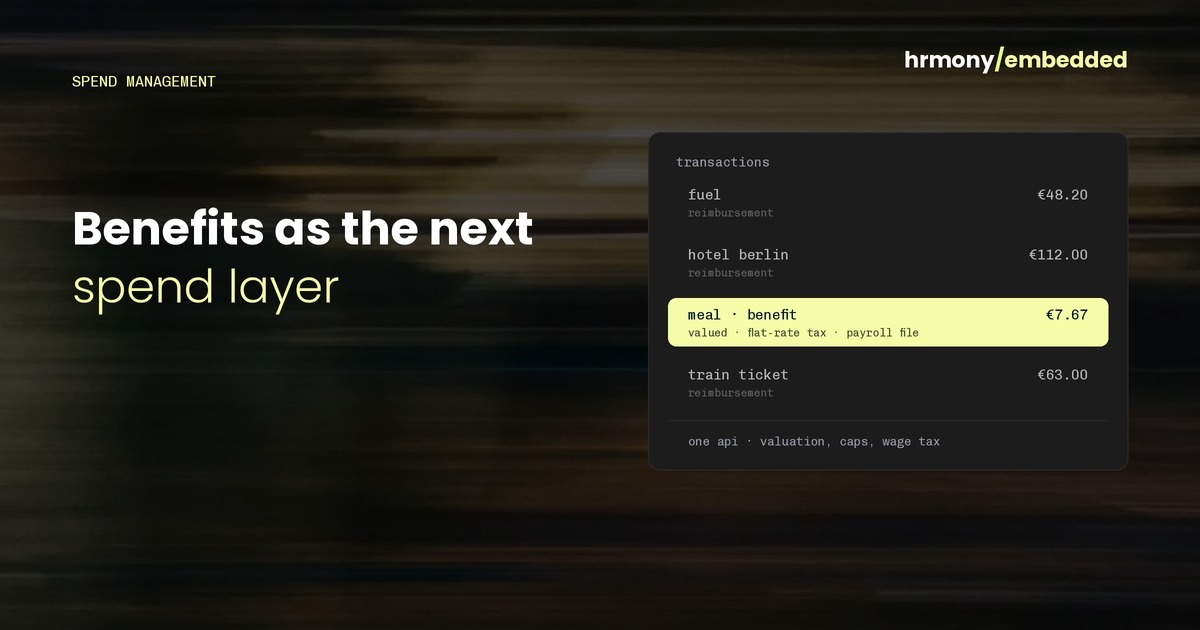
Summary
- A spend platform already owns the card, the receipt, and the payout. A benefit adds no new mechanics – it adds a different legal consequence.
- Reimbursement is not a benefit: an expense claim returns business costs, a benefit creates a taxable non-cash advantage with its own valuation, cap, and payroll reporting.
- Germany's meal subsidy is tied to workdays without business travel – and the travel data that decides it already sits in your expense records.
- Three modules fit first: Meal (up to €7.67 per workday), Voucher (€50 monthly exemption), Mobility (public transit, no fixed cap).
- Benefit tax logic is national, not global – plan one market and one module at a time rather than a single worldwide feature flag.
Your platform already runs the pipes – benefits add the tax logic
A spend management platform handles three objects: a card, a receipt, and a payout. Tax-advantaged employee benefits are built from the same three. What's missing isn't the mechanics; it's the legal consequence. An expense claim returns money the employee spent on the company's behalf. A benefit creates a non-cash advantage that has to be valued for wage tax purposes. Embedded benefits means you keep the card, the receipt inbox, and the approval flow, and pull the valuation and wage-tax logic in through an API.
If you want the category first, what are embedded benefits explains the model independent of any vertical.
What a benefit needs that your product already has
Four things a benefit requires are standard in spend products: card issuing with per-user and per-category limits, receipt capture with OCR and transaction matching, an approval workflow with roles and exceptions, and export into accounting and payroll. That's a bigger head start than most HR systems have when they launch a benefit. The gap sits somewhere else.
Where expense logic ends and benefit logic begins
| Expense reimbursement | Tax-advantaged benefit | |
|---|---|---|
| What moves | repayment of business costs the employee incurred | a non-cash advantage to the employee |
| Wage tax | tax-free reimbursement is possible | taxable unless an exemption or a flat-rate scheme applies |
| Caps | measured against deductible expenses and per-diem rates | a separate cap per module (€50 per month, €7.67 per workday) |
| Receipt check | was the spend business-related | is it eligible, how is it valued, what did the employee contribute |
| Output | journal entry, cost center | wage-tax file, entry in the payroll record |
| Retention | booking records, 8 years | payroll accounts, 6 years |
Two rows carry the work: the receipt check and the payroll output. A €12 restaurant receipt tells an expense engine whether the spend was business-related. It has to tell a benefit engine whether this was a main meal on a workday, which portion is valued at the official meal rate, and how much of that is taxed at the flat rate. Same artifact, different examination. The same dividing line runs through neighboring systems – for how it looks in accounting and tax platforms, see embedded benefits for accounting.
The travel-day advantage
This is where the adjacency stops being an analogy. Germany's meal subsidy applies to workdays without business travel; for the first three months of a business-travel assignment a different valuation applies. The rule of thumb: day by day, never both on the same day. The reverse matters too – a meal voucher the employee redeems themselves does not reduce the per-diem. The per-diem is only reduced when the employer actually provides the meal.
Which employee traveled on which day is rarely complete in an HRIS. In a spend platform it's complete by definition, because you run the travel expense report. When the benefit module and travel expenses live in the same product, one of the most common sources of error becomes a rule that fires on its own.
Where the module sits
Not in a new tab. A benefit budget behaves like another spend category with its own rules: the admin assigns it per group, the employee submits the receipt in the same inbox, approval runs through the same workflow. Technically it's three touch points – user sync, entitlement per user per month, and a monthly payroll file. Everything in between (valuation, cap checks, flat-rate tax calculation) stays inside the module.
Three modules that fit first
The values below are German, 2026.
Meal. Valued at the official meal rate of €4.57 per lunch or dinner plus a tax-free employer top-up of €3.10, for a maximum of €7.67 per workday. Under the 15-day rule that comes to €115.05 per month and €1,380.60 per year. The employer pays a 25% flat-rate tax, and only on the non-cash advantage – the official rate minus the employee's own contribution. If that contribution reaches €4.57, the flat-rate tax disappears entirely. It depends on the amount on the submitted receipt, which makes it a UI decision, not a footnote.
Voucher. A €50 monthly exemption, with no carry-over into the following month. It's a threshold, not an allowance: at €50.01 the whole amount becomes taxable, not just the excess. The voucher has to be granted on top of salary; salary conversion is ruled out.
Mobility. A public transit subsidy is free of tax and social contributions with no fixed cap, up to the actual ticket cost. In exchange it reduces the employee's commuting deduction one-to-one. At Hrmony, Mobility covers public transit only – it isn't a full mobility budget. Reference point for 2026: the Deutschlandticket at €63 per month.
Your corporate card is not a benefits card
The obvious move is to put the benefit budget on the card you already issue. That doesn't hold without checking. The €50 exemption requires the card to be structured in line with German payment services law – a property of the card product, not of the booking process. A general-purpose corporate card doesn't acquire it because a budget with a benefit label lands on it. Either the card demonstrably meets the requirement, or you use a module that brings its own.
One market at a time
Everything above is German. That's the point, not a limitation of this article: benefit tax logic is national. Rates, caps, flat-rate schemes, and retention periods are written per jurisdiction, which means benefits aren't one feature you ship globally – they're one module per market, with its own valuation rules and its own liability question. For a spend platform operating in several countries, the sensible sequence is the market where your user base is densest and where a provider already carries the receipt-checking and liability work, then the next one. Treating it as a single configuration flag is how build estimates go wrong.
What it does to your revenue line
Benefits are recurring and per user: per active module, per user, per month. For a platform billing on transaction volume or per seat, that's a second revenue line on the same user base without building tax logic and receipt checking yourself. The arithmetic is in benefits as a revenue stream for platforms.
One note on liability, because vendor answers here tend to be vague: Hrmony assumes liability for the receipts checked under its individual receipt-checking process in the Meal module. That doesn't extend to the other modules. Ask the question module by module – the criteria are in how to choose an embedded benefits provider.
If you want to see how a benefit module maps onto your card and receipt model, the Embedded overview shows modules, API, and operating model together.